Home
Plant Physiologist focused on dormancy regulation, cold tolerance, and phenology modeling in temperate perennial crops. Developed Low Temperature Exotherm Ratios (LTER), a physiology-based framework for quantifying floral dormancy through changes in deep supercooling capacity.

Bio
My research focuses on understanding how dormancy, cold tolerance, water relations, and flowering phenology interact during seasonal transitions in temperate fruit crops. I am currently an ORISE Postdoctoral Research Fellow conducting grapevine abiotic stress genetics and genomics research with the USDA Agricultural Research Service’s Grape Genetics Research Unit (GGRU) at Cornell AgriTech. My overarching goal is to improve the stability and resilience of fruit crop production systems by advancing our understanding of plant stress physiology and translating that knowledge into tools and strategies for crop improvement, adaptation, and management.
My dissertation research integrated multi-trait phenotyping, transcriptomic analyses, and genomic marker development to investigate cold tolerance regulation in sweet cherry while identifying stage-specific transcripts associated with cold tolerance across dormant and flowering stages of development. This work was guided by the development of Low Temperature Exotherm Ratios (LTER), a quantitative framework for tracking floral dormancy through changes in deep supercooling behavior. LTER enables phenological tracking of dormancy progression and can be integrated with physiological and environmental data to support predictive models of dormancy status, cold hardiness, water relations, and bloom timing. My earlier research in Malus domestica focused on identifying historic apple cultivars in abandoned homesteads in Wyoming and national parks in California using SSR-based genotyping, linking molecular identification with conservation and regional cultivar evaluation. This work established my broader interest in integrating molecular tools with horticultural physiology across perennial fruit systems and identifying cold-tolerant genotypes suited for regional production systems.
Featured Projects
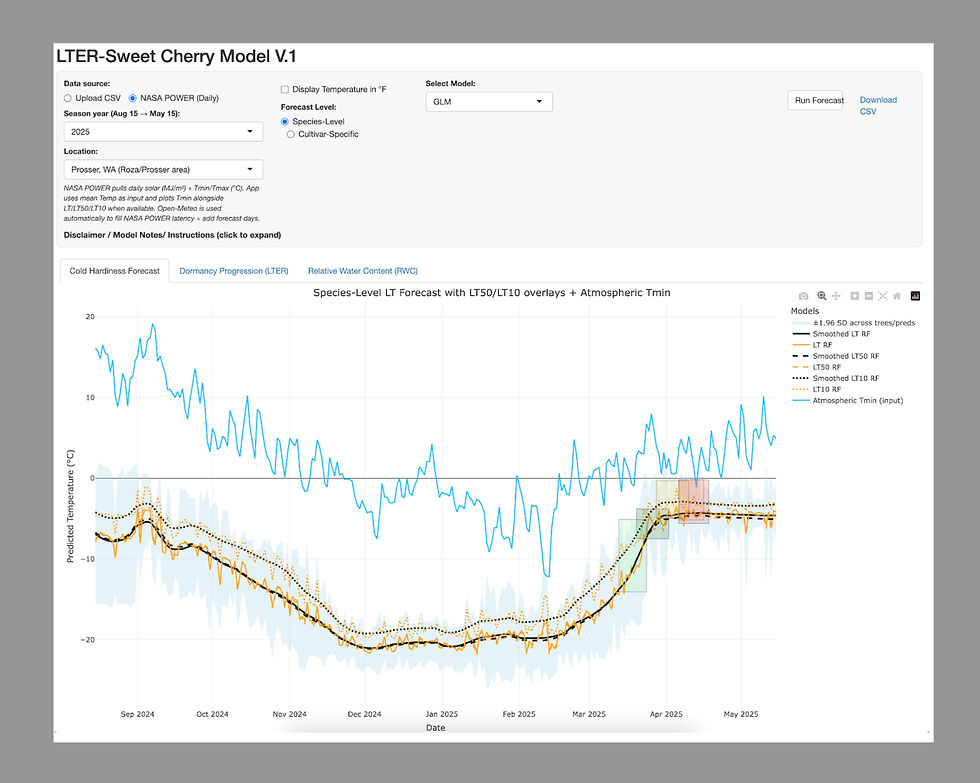
LTER–Sweet Cherry Model v1: Now live (open beta)
A phenology forecasting tool that integrates dormancy progression, cold hardiness modeling, relative water content dynamics, and environmental data to estimate developmental state and freeze risk in sweet cherry. The application provides interactive time-series visualizations to help growers, researchers, and industry professionals interpret seasonal bud development and potential freeze risk.
Outputs
The model generates outputs at both the species level and for 12 sweet cherry cultivars, including:
-
Dormancy progression using Low Temperature Exotherm Ratios (LTER)
-
Relative water content (RWC) predictions
-
Cold hardiness estimates (LT, LT10, LT50)
Current Features
Model features include:
-
12 preset orchard regions across CA, MI, NY, OR, WA, France, and Spain
-
Custom location mode using user-entered latitude and longitude
-
14-day weather forecasts via the Open-Meteo API
-
Historical climate data selection (2019–present) via the NASA POWER API
-
Daily minimum temperature (Tmin) tracking
-
Visual risk markers for LT10 and LT50 thresholds